
Resilience as Infrastructure
June 24, 2026 2026-06-24 18:39Resilience as Infrastructure
A Different Operating System
Why Strong Leaders Move Before They Have the Answers
For most of a decade, a leading edtech company had a strategy that worked. They knew their buyers, they knew what converted, and they moved with the confidence that comes from winning. When they saw an opportunity, they ran at it, and the first move usually landed.
Then the ground moved.
New entrants crowded in. AI showed up in every roadmap at once. The pandemic surge that had made demand feel limitless was over.
For a while the top-line number held up, which made it easy to miss what was happening underneath. Renewals and expansions kept getting a little harder every year, and the moves that had always helped weren’t working anymore. Eventually the headline number started reflecting it too.
There had also been a few rounds of restructuring—necessary, but the kind that leaves people watching their footing.
But that’s not actually the interesting part.
The real problem wasn’t the strategy.
When Fear Makes the Thinking Smaller
After enough didn’t go to plan, fear set in. And fear did what it does: it made the thinking smaller.
People grew cautious, risk-averse, reluctant to commit. They told themselves a story to explain the caution:
We got burned, so let’s play small and wait until things are clearer.
The waiting felt like prudence. It was actually the problem.
A company that had always moved decisively now sat still, each person half-believing the signal to move had to come from somewhere else. Nothing about the market required that response. The same conditions could have produced small bets, fast learning, and a dozen experiments. What the company was missing wasn’t a better plan. It was a way to move while the picture was still forming.
The problem was waiting for uncertainty to disappear before acting.
Because the uncertainty didn’t go away while people waited. The questions were still there, still needing answers. They just sat unanswered, each person assuming the next move belonged to someone else.
The Leaders Who Moved First
The turn didn’t come from the top handing down certainty.
It came from a handful of leaders—scattered across the organization, not all senior—who were simply willing to operate without a crystal ball and to say so out loud.
What stood out about them was that they weren’t the confident ones. They were the opposite of cavalier.
At every turn they were honest about what they knew and what they didn’t, and they moved anyway, making decisions with the information available rather than waiting for certainty. Where things were murky, they worked to clear a little of the murk rather than treating it as a reason to stop.
And they did it by going outward.
The instinct under fear is to pull inward, into your own function, your own head, your own private weather system of worry.
These leaders did the reverse. They got closer to the customer. They went to other functions and asked what they were seeing.
The company had the usual fault line between product and go-to-market. In steady times it didn’t matter much. Under pressure it became a real liability, each side holding half the picture and neither able to decide well alone.
The leaders who broke the freeze refused to decide in a silo because they understood that the thing they didn’t know was usually sitting with someone they hadn’t asked.
This is the move leaders quietly resist. Saying “I don’t know yet, help me see it” feels like weakness. Pulling other voices in feels like it slows you down at the exact moment speed matters. It does neither.
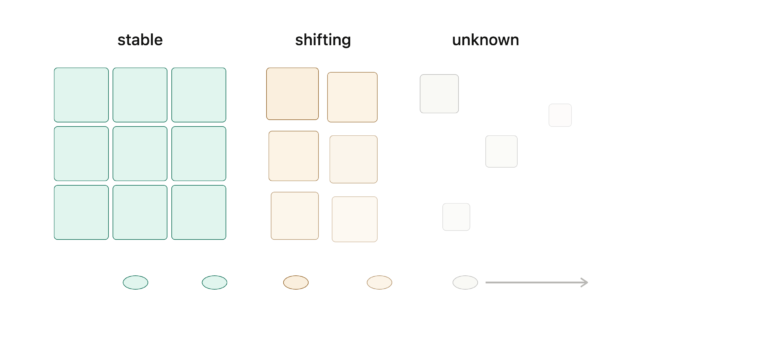
The leaders who moved first were unusually clear about three things: what they knew, what was shifting, and what they didn’t know yet. That clarity made it easier to bring in other perspectives and make decisions at the right size.
Admitting the edge of your own knowledge is what lets other people fill it. It also lets you size decisions to reality rather than wishful thinking—moving decisively where you can, staying flexible where you should, and learning where you must.
In uncertainty, that’s not a brake. It’s the accelerator. It only looks slow from inside the silo.
Ownership Is the First Thing Fear Takes
There was one more thing these leaders did, and it’s the part that’s portable to anyone.
They operated with ownership inside whatever they actually controlled, even when the answer from above was no, or stop, with no explanation attached.
The easy story after hearing no a few times is that someone else wants to control the decisions, so why bother. It’s a tempting story because it lets you stop trying. These leaders refused that story.
They took the constraint as given and looked for what was genuinely theirs to own inside it. Being told no on one thing, even without explanation, didn’t stop them from acting on everything else that remained within their control.
They kept moving, learning, and deciding where they could.
And because they modeled that posture themselves, others began doing the same, trading permission-seeking for ownership and action.
The quiet damage fear does isn’t the stress people feel under it.
It’s how easily and how unconsciously they hand their ownership away.
A Shared Language for Uncertainty
The behavior didn’t start with DIG.
A few leaders were already operating this way. What DIG provided was a shared language and discipline that helped the behavior spread beyond those individuals. DIG stands for three moves:
Discover — name what’s actually known, what’s shifting, and what’s still unknown.
Integrate — pull in the perspectives you’re missing before you decide.
Go — make the smallest committed move you can learn from.
Introduced to the leadership team months earlier, it gave people a way to recognize, discuss, and reinforce the practices that were helping them move forward when certainty wasn’t available. The acronym was never the point.
What mattered was that leaders suddenly had a common way to talk about uncertainty. They could distinguish between what they knew, what was shifting, and what they didn’t know yet. They could pull in perspectives they were missing. They could make decisions at a size that matched the information available.
The shift didn’t come from sitting through the model. It came from leaders choosing, in real decisions under real pressure, to use it. What had previously lived in pockets started becoming a shared way of operating.
What Changed
As those leaders modeled it, other people started doing the same.
Not because anyone mandated it, but because they could see it working. Slowly, others stepped in alongside them. What changed wasn’t a new strategy or a sudden burst of confidence. It was something much simpler: None of us has a crystal ball, and we’re going to move anyway. Permission to not-know turned out to be permission to act.
The behavior changed in concrete ways. A culture of sliding commitments gave way to something sturdier. Decisions stopped waiting for certainty that was never going to arrive. The work of figuring things out moved sideways, into the room and out to the customer, instead of stalling while everyone looked around for someone else to go first. The shift was narrower and deeper than structure.
The company moved from waiting out uncertainty to operating inside it—pragmatic about the limits of what it knew, actively in learning mode, willing to make appropriately sized moves and bring people along on the way.
That distinction is the whole thing. When results disappoint, the easy story is that the situation calls for playing small until it clears. It rarely does.
It usually calls for a different operating system, one that treats not-knowing as a condition to work inside rather than a reason to wait.
This client is still in a hard market. The competitors didn’t leave, and AI didn’t slow down.
But for the first time in three years, the projection points up instead of down. The shift didn’t come from the market easing. It didn’t come from finally getting the answers.
It came from a few people who stopped needing the answers first—who learned to move while the picture was still forming and brought everyone else along until that became how the team operated.
That’s the thing worth taking from it. The organizations that adapt aren’t the ones that get answers faster. They’re the ones that learn how to move while the answers are still emerging.
If This Feels Familiar
If you recognized your own organization in this, the waiting, the hesitation, the sense that everyone is looking around for someone else to move first, that pattern rarely resolves on its own. It changes when leaders learn how to operate before certainty arrives. That’s the work we do.
If you’d like to talk through where your organization might be stuck and what the first move could look like, we’d be glad to compare notes.
If you’re also navigating execution drag, you may want to read:: How Leaders Can Build Teams in a World of Uncertainty
